
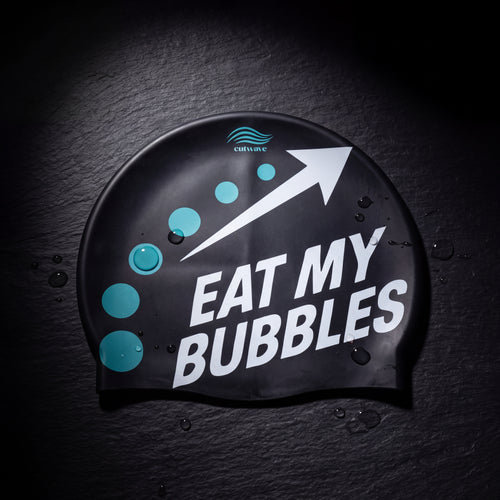
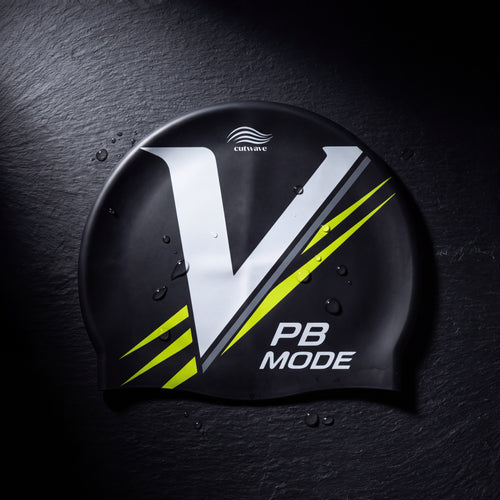


A standard silicone or latex swim cap goes on with its centre crease or seam running from the middle of your forehead to the nape of your neck—not from ear to ear. Put the printed design on the outside, centre it before stretching, and keep the rim level rather than twisting the cap sideways.
That orientation gives you the right starting point, but it is not a magic front-versus-back puzzle: many plain moulded caps are nearly symmetrical. The useful landmarks are the centre line, the printed design, the front hairline and an even rim. U.S. Masters Swimming gives the same seam rule in its cap fitting guidance.
Find the centre line before you stretch the cap
Lay the cap flat on a dry bench or hold it by the rim with both hands. Look for the line left by the mould, a packaging crease, or the visual centre of the printed design. On a typical silicone cap, that line should travel over the crown from front to back when worn.
Aquabliss describes the same alignment in its swim cap control and care guide: the crease runs from the centre of the forehead, over the top of the head, to the neck. Their practical comparison is useful—think of the line where a shark fin would sit. If the line ends above each ear, the cap is rotated by 90 degrees.
- Printed silicone cap: keep the artwork outside and use it as a visual centring guide.
- Plain moulded cap: use the centre crease or seam rather than hunting for a dramatic front panel.
- Panelled fabric cap: follow the shaped panels, label and manufacturer markings; its construction may have a clearer front and back.
- Long-hair or shaped cap: put any extra volume where the cap was designed to hold it, usually toward the back.
Use this four-step orientation check
- Face the design outward. If the cap carries words or a graphic, check that they are upright before your hands go inside. This is faster than trying to rotate a tight cap on your head.
- Put the centre line between your hands. Hold the cap by the left and right sides of the opening, with the crown seam centred between your hands and running away from your face.
- Set the front edge first. Place it around the centre of the forehead or just above the hairline, depending on your fit, then guide the rest over the crown toward the nape.
- Check the rim. It should sit evenly on both sides. Smooth folds with finger pads and decide whether your ears feel better fully covered or outside; avoid leaving one side folded differently from the other.
For the complete hand movement, hair setup and a second-person method, use the step-by-step swim cap fitting guide. If long nails make the rim hard to handle, follow the separate method for putting on a cap with long nails rather than pinching the silicone.
What correct orientation looks and feels like
Stand in front of a mirror before getting in. The centre line should look straight from forehead to crown. A printed logo or phrase should be upright rather than leaning toward one ear. The left and right edges should reach similar points around the temples and ears.
Use a 30-second mirror test. First trace the centre line with one flat finger from forehead toward the crown. Next compare the rim above the left and right ears. Finally read the design in the mirror. Pass means a straight centre line, similar rim height and upright artwork. If the line runs sideways or the design leans, remove and reset the cap. If all three checks pass but the cap still hurts or rides up, orientation is not the problem—check size, hair placement and edge tension instead.
Then use feel, not just appearance. Run one finger pad around the rim. You are checking for a rolled edge, trapped hair, a fold above one ear or a thick pocket of air at the crown. Press air out gently with a flat palm. Do not dig a nail under the material or yank one side farther down to compensate for a crooked start.
The cap may still feel wrong even when the seam is straight. That usually points to fit, hair placement or application rather than direction. A high bun can create a cone at the crown; many swimmers find that a lower, flatter hair arrangement distributes the volume more evenly. A cap that creeps backward needs the troubleshooting steps in the swim cap slipping guide. Repeated pressure or a headache calls for a fit check, not another quarter-turn.
| What you notice | Most likely category | What to do next |
|---|---|---|
| Seam ends above the ears or artwork leans | Orientation problem | Remove the cap, centre it and refit |
| Seam is straight but one rim edge is rolled | Application problem | Reseat the edge with finger pads |
| Seam and rim are even but pressure persists | Fit problem | Check size and hair volume |
| Everything looks even but the cap moves in water | Fit, hair or material problem | Use the slipping-cap checklist |
Front, back and ear choices in common situations
| Situation | Orientation decision | Final check |
|---|---|---|
| Regular pool training | Centre line from forehead to nape; design outward | Rim flat and hair tucked without sharp clips |
| Long or thick hair | Keep extra cap volume and hair mass toward the back | No tall lump forcing the front edge upward |
| Racing with goggles | Orient the cap first, then place the goggle strap consistently | Practise the full setup before race day |
| Child learning to swim | Adult centres the line while the child holds the front edge | Child can hear instructions and the cap feels comfortable |
| Open water | Use the intended outside and keep the cap centred | Follow event rules and choose visibility for the conditions |
Ear coverage is a preference and fit decision, not the clue that tells you which end is the front. Cover both ears, leave both out, or cover them partly if that is comfortable and permitted. The important part is symmetry: a rim that sits much higher on one side often means the cap was twisted during fitting. If goggles are part of the confusion, the guide to wearing goggles over or under a swim cap separates the training and racing setups.
Mistakes that make a correctly oriented cap feel wrong
- Starting sideways: the centre line runs ear to ear, so one side of a printed design may disappear toward the back.
- Rotating it while worn: stretched silicone can drag against hair and skin. Take it off, reset it and start again.
- Using the ears as the only landmark: ear coverage varies by head shape, cap size and preference. Use the crown line first.
- Pulling only the back edge: this can roll the rim or create a large air pocket on top.
- Assuming direction fixes size: a cap that causes strong, persistent pressure or repeatedly rides up may need a different fit. The swim cap size guide gives a mirror test.
- Ignoring the product design: panelled, shaped and long-hair caps can have construction cues that matter more than the generic seam rule.
If you want a printed silicone cap whose upright design makes the outside easy to recognise, browse the CutWave swim cap collection. Pick by design after you have checked the material and fit you actually need.
FAQ: swim cap direction and orientation
Does a swim cap have a front and back?
Some do, especially shaped, long-hair or panelled caps. A plain moulded silicone cap can be close to symmetrical. Use the centre seam or crease, upright artwork and any manufacturer markings to orient it.
Should the swim cap seam go front to back?
Yes. On a standard silicone or latex cap, align the centre line from the middle of the forehead over the crown to the nape. It should not run from one ear to the other.
Can I wear a silicone swim cap inside out?
A plain cap may still stretch over your head when reversed, but that is not a reliable fit fix. Keep printed artwork on the outside and follow any texture, label or construction cues supplied by the maker.
How do I know if my swim cap is sideways?
Check whether the centre line ends above the ears, the design tilts, or the rim sits much higher on one side. Remove the cap and reset it rather than twisting it while stretched.
Which side of the cap should cover my ears?
There is no separate ear side. Once the centre line is front to back, choose equal coverage on both ears based on comfort, hearing needs, fit and any event or pool rules.